

Thonest Review: Verified Revenue Timelines for Founders
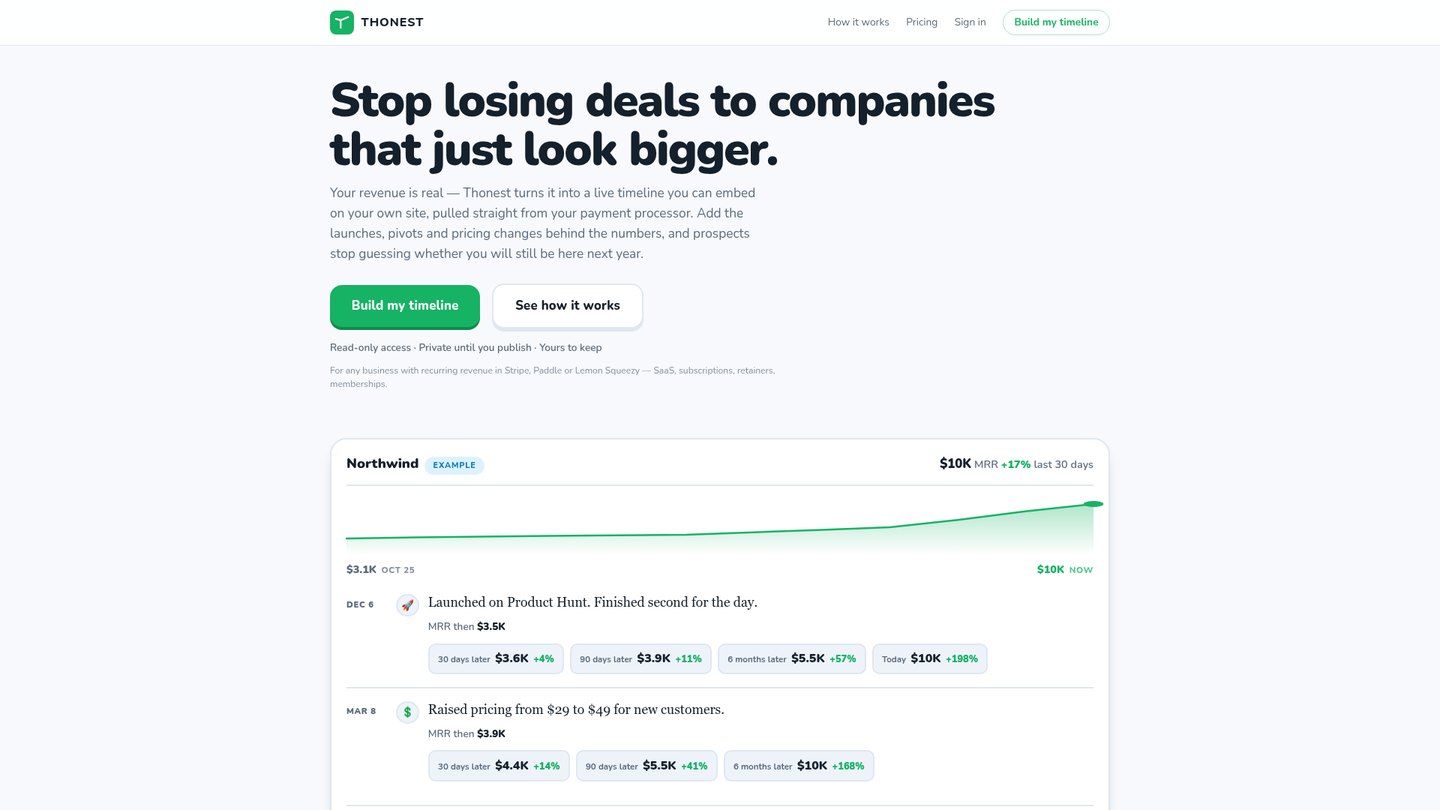
Every founder has had the same sinking feeling on a sales call: the prospect likes the product, but you can tell they are wondering whether your company will still exist next year. Thonest is a revenue-transparency SaaS built to answer that question with receipts. It connects to your payment processor and turns your real revenue history into a live, verified timeline you can publish and embed on your own site.
The product is aimed at subscription businesses: SaaS companies, agencies on retainers, membership sites, and anyone billing through Stripe, Paddle, or Lemon Squeezy. Instead of asking you to type numbers into a dashboard, Thonest reads your payment history, rebuilds your MRR and customer count month by month, detects milestones automatically, and lets you add dated founder annotations so the story behind each number is visible. The result is a public page and a one-line embed that updates itself as your revenue moves.
This review is based on the live product, its public example timeline, and its published pricing and documentation. We did not run a paid account through a full billing cycle, and we say so up front because the whole point of Thonest is that claims should be verifiable. Here is what it does, what it costs, and who should actually use it.
What Is Thonest?
Thonest is a revenue transparency tool for businesses with recurring revenue. You connect Stripe, Paddle, or Lemon Squeezy, and it rebuilds your revenue history automatically, month by month, as far back as your payments go. The result is a public page at thonest.com and an embeddable widget that shows your MRR, your customer count, and the story behind the numbers.
The target user is clear: SaaS companies, subscription businesses, agencies on retainers, and membership sites. In other words, the same founders and small teams who read this magazine and buy design services. If you have ever lost a deal to a bigger-looking competitor, that is the exact problem Thonest is aimed at. Its homepage pitch is blunt: stop losing deals to companies that just look bigger.
How Does Thonest Work?
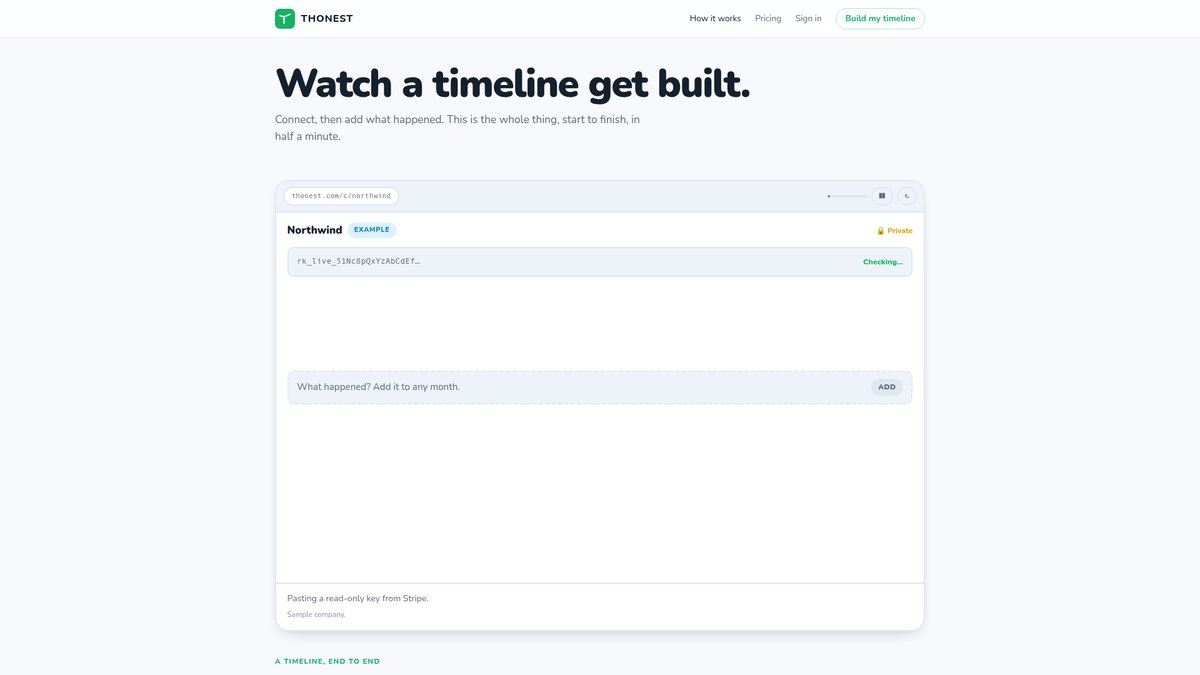
The setup is deliberately simple, and the how-it-works page walks through the whole thing end to end:
- Connect your payment processor. With Stripe, you paste a read-only key, so Thonest can read your history but never touch your money. Paddle and Lemon Squeezy connections are also supported for businesses that bill through those platforms.
- The timeline builds itself. Instead of a form, you get your full history back in about a minute: every month of revenue, your customer counts, and milestones the detector finds on its own, like your first $1K month, all-time highs, and even your lowest month. Thonest is explicit that a tool which only surfaces good news would be a highlight reel, so the low points stay in.
- You add the story. The only typing involved is annotating what happened: a Product Hunt launch, a pricing change, a pivot, a key hire. Each note arrives with the numbers from its own date already attached, plus what the business did 30 days, 90 days, and 6 months after.
- You publish when you are ready. Everything stays private until you say so. Once published, anyone can read your timeline for free, with no account and no paywall.
The Verified Revenue Timeline
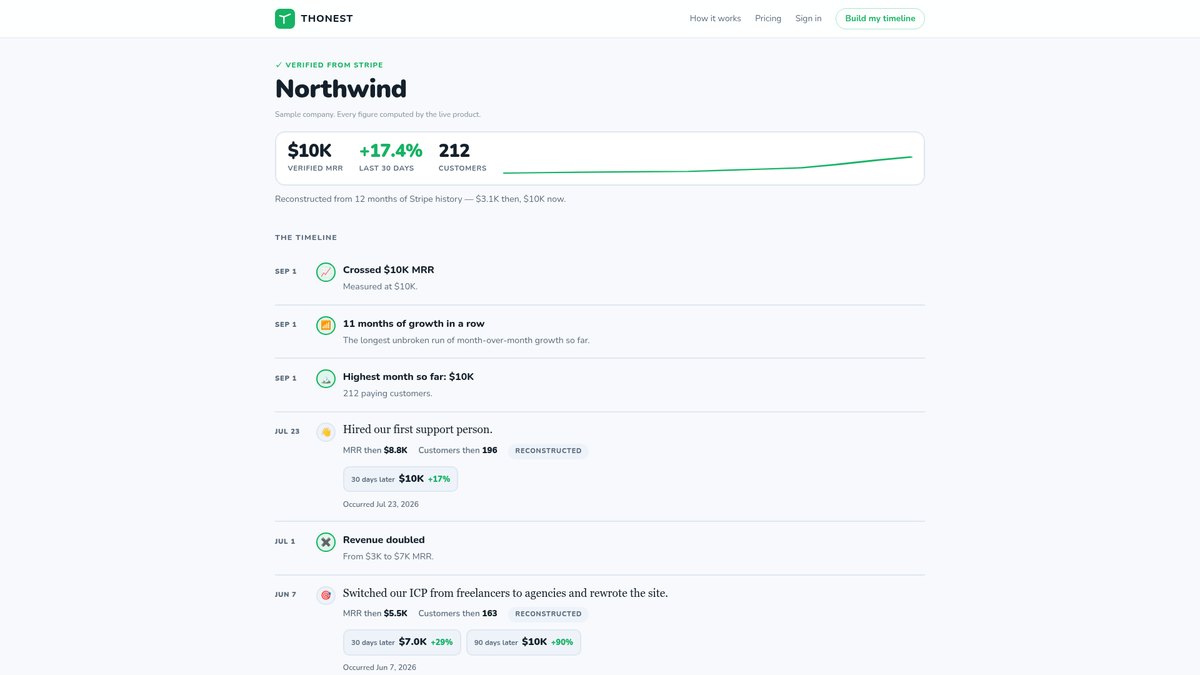
The heart of the product is the public company page. Thonest hosts a fully worked example timeline for a sample company called Northwind, with every figure computed by the live product, and it shows exactly what a reader sees.
The page leads with verified MRR, recent growth, and customer count, followed by the timeline itself. What makes it more than a chart is the combination of two layers:
- Founder annotations. Short notes like "Raised pricing from $29 to $49 for new customers," each pinned to the MRR and customer count on that exact date, with follow-up figures showing what happened next.
- Detected milestones. Events nobody typed: crossing $5K MRR, revenue doubling, 11 months of growth in a row. These are dated by the detector reading the history itself.
Every figure carries a "verified" or "reconstructed" marker. Verified numbers come straight from the processor. Reconstructed ones are rebuilt from history and labeled as such. That labeling discipline is the product's real claim to credibility: a figure with nothing standing behind it is just a number you typed, and visitors already discount those.
Embedding It On Your Own Site
A timeline on thonest.com is useful; the same timeline on your own about page is the actual pitch. Publishing gives you a link to share, and one line of code drops the verified history into your own site, where it keeps updating itself as your revenue moves. No screenshots to redo, no "trust us" copy to write.
One design note our readers will appreciate: the verified mark never comes off. Paid plans can restyle the embed to match your site's fonts, colors, and corners, but the mark stays, because the mark is the claim. It is a refreshingly principled stance in a category where most badges are for sale.
Thonest Pricing
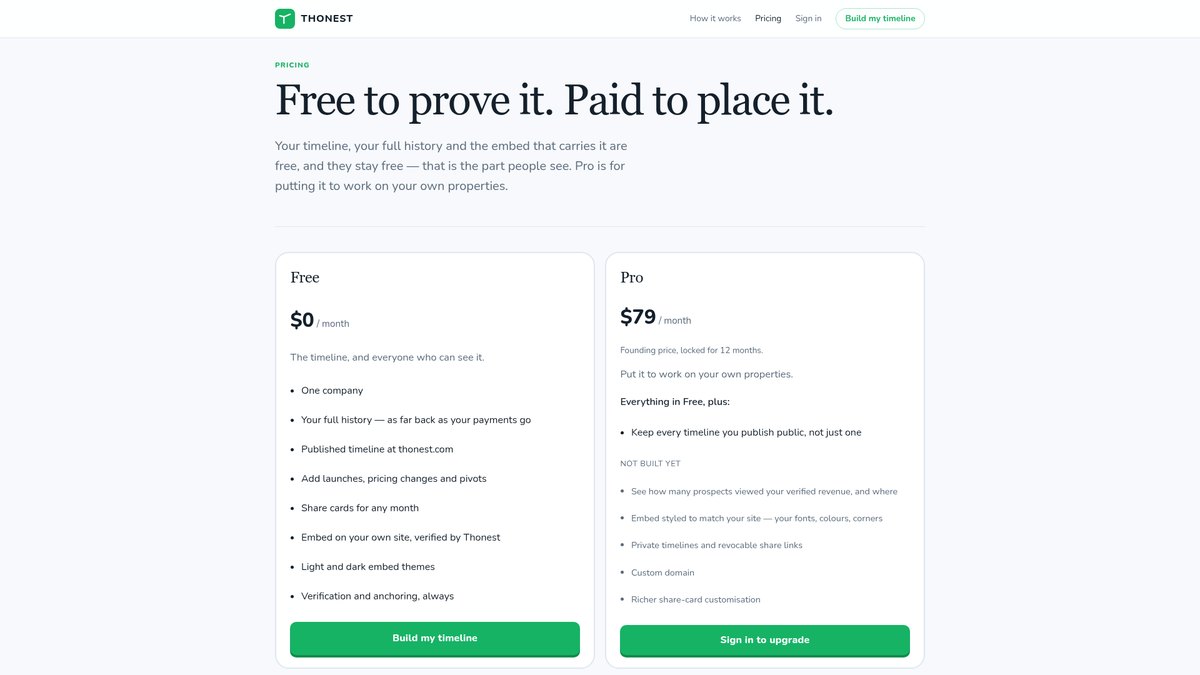
Thonest's pricing page frames the split as "free to prove it, paid to place it," and the structure matches that promise:
Free: $0 per month
- One company, with your full history as far back as your payments go
- Published timeline at thonest.com
- Add launches, pricing changes, and pivots
- Share cards for any month
- Embed on your own site, verified by Thonest
- Light and dark embed themes
- Verification and anchoring, always
Pro: $79 per month
The $79 rate is a founding price, locked for 12 months. Pro is aimed at putting the timeline to work across your own properties and includes everything in Free, plus the ability to keep every timeline you publish public rather than just one. The pricing page is unusually transparent about the rest: viewer analytics, site-matched embed styling, private timelines with revocable share links, custom domains, and richer share-card customization are all listed under a literal "not built yet" label.
Two policies stand out. First, your history is never a paid feature: a timeline that shortens when a card declines would be a record that lies by omission, so the full record stays free on every plan. Second, reading a timeline is always free, with no account and no wall, which matters when you are sending it to a prospect.
Who Is Thonest For?
Thonest makes the most sense for a specific kind of business: recurring revenue, a few years of runway or less, and a sales process where prospects hesitate because you look small. Agencies on retainers, bootstrapped SaaS, and membership businesses fit that profile well. If you bill through Stripe, Paddle, or Lemon Squeezy and your growth story is genuinely good, this turns that story into an asset on your own site.
It makes less sense if your revenue is flat or declining, since the detector reports the low months too. It also makes less sense if you bill mostly by invoice or one-off projects, because there is no recurring-revenue history to verify.
Pros and Cons
What we like:
- The numbers are read from your payment processor, not typed in, and reconstructed figures are labeled as such
- The timeline builds itself from your history instead of asking you to fill in a form
- Annotations tie real decisions to real figures, which is the context a raw chart never gives
- The free tier is genuinely useful: full history, a published page, and the embed
- The verified mark stays on every embed, even on paid plans
Where it falls short:
- It is a young product, and several Pro features are openly listed as not built yet
- The free plan limits you to one public timeline
- It only works for recurring revenue in Stripe, Paddle, or Lemon Squeezy; invoice-heavy businesses are out
- Radical transparency cuts both ways: slow months and low points are part of the record
Final Verdict
Thonest is a focused, transparent take on a real problem: small companies with real revenue losing deals to bigger-looking competitors. The product does one thing, does it with unusual honesty about its own limitations, and charges nothing for the part most founders actually need. If you run a subscription business and your numbers tell a good story, the free tier is worth the ten minutes it takes to connect. We will revisit this review as the "not built yet" Pro features ship.
Thonest FAQ
Is Thonest free?
Yes. The timeline, your full history, and the embeddable widget are free on the Free plan. Pro costs $79 per month at a founding price locked for 12 months and adds multi-timeline publishing and, once shipped, analytics and customization features.
Which payment processors does Thonest support?
Stripe, Paddle, and Lemon Squeezy. It is built for recurring revenue: SaaS, subscriptions, retainers, and memberships.
Does Thonest have access to my money?
No. The Stripe connection uses a read-only key, so the product can read your history but cannot move funds. Nothing is public until you choose to publish.
Can I put a Thonest timeline on my own website?
Yes. Publishing gives you a shareable link and a one-line embed for your own site. The embed updates itself as your revenue moves, and the verified mark stays on it.
What happens if my revenue dips?
The dip shows up. Thonest's milestone detector reports low points as well as high ones, which is the price of a record people can trust.