

Thonest vs TrustMRR: Which Revenue Verification Tool Wins?
If you are searching for a TrustMRR alternative, you are almost certainly trying to solve one problem: prospects, partners, or buyers do not believe your revenue numbers, and a screenshot of a Stripe dashboard is not proof. Two products answer that with verified, payment-provider-backed data. They answer it in very different places.
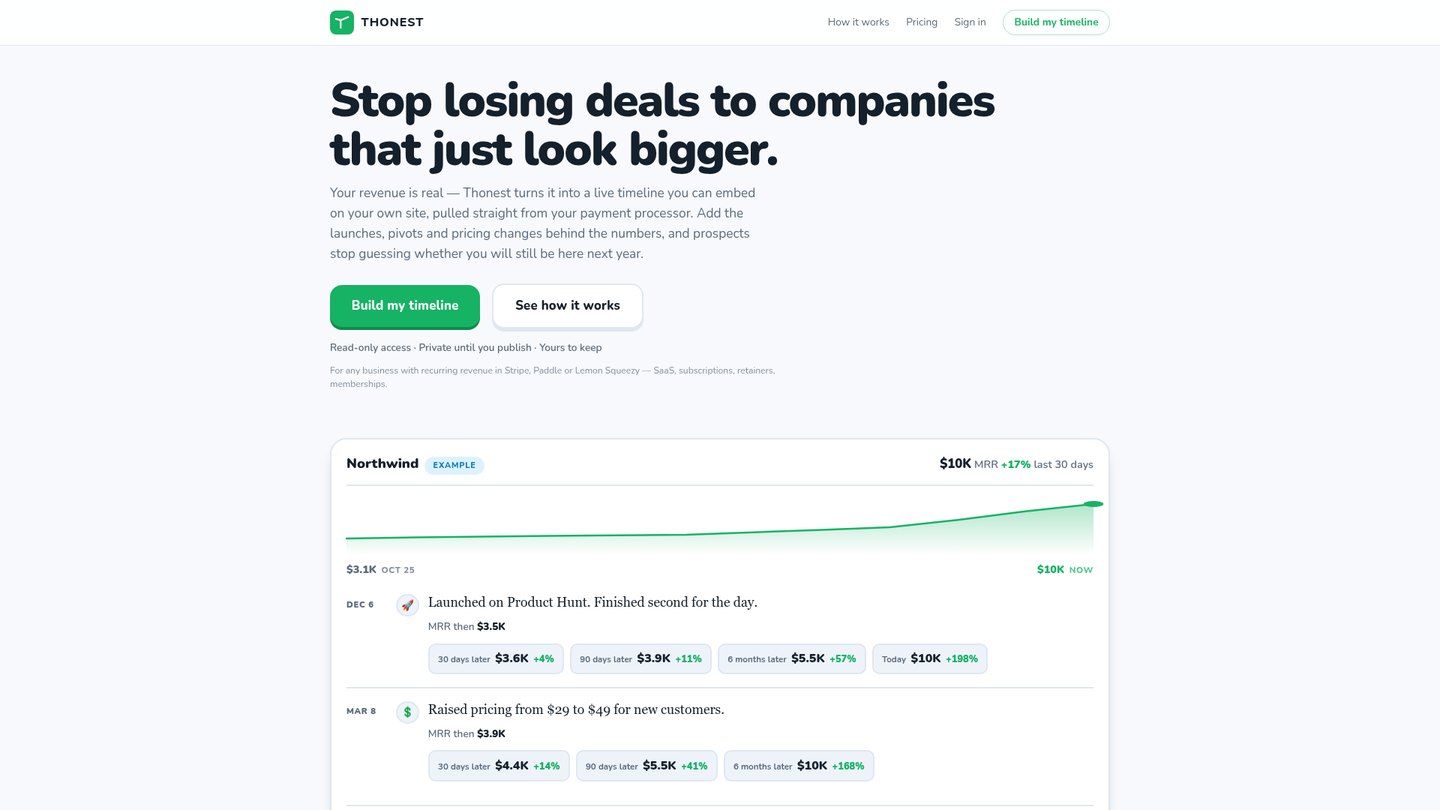
TrustMRR is a public database and acquisition marketplace. You connect a read-only payment key, your startup gets a profile on their site, and buyers browse it alongside thousands of others, many of them listed for sale. Thonest is a verified revenue timeline that lives on your site. You connect Stripe, Paddle, or Lemon Squeezy, it rebuilds your revenue history month by month, and one line of code embeds that verified history on your own homepage, about page, or pricing page.
That single difference decides almost everything below. If your goal is to sell the company, TrustMRR's marketplace is where the buyers are. If your goal is to win deals, close customers, and stop looking smaller than you are, Thonest is the obvious choice, and it costs nothing to prove it.
Thonest vs TrustMRR At A Glance
| Thonest | TrustMRR | |
|---|---|---|
| What it is | Verified revenue timeline you embed on your own site | Public startup revenue database and acquisition marketplace |
| Primary job | Convince prospects and customers you are real and growing | Get your startup discovered by buyers and browsers |
| Where your numbers live | Your domain, via a one-line embed, plus a public page | A TrustMRR profile page alongside 15,000+ other startups |
| History depth | Full history rebuilt from your payment records, free on every plan | Verified revenue, MRR, customers, churn; deeper timelines require an account or paid API access |
| Narrative | Founder annotations dated to launches, price changes, and pivots, with 30, 90, and 180-day follow-up numbers | Profile fields, insights, and a public founder feed |
| Milestones | Detected automatically, including low months | Rankings and growth metrics across the database |
| Cost to start | $0, includes full history, published page, and the embed | $0 to list; visibility and trust add-ons are paid |
| Paid tier | $79/mo founding price, locked 12 months | Sale listings at $29, $199, or $499; add-ons at $19 and $79; sponsor spots from $399 |
| Best for | SaaS, agencies, and membership businesses selling to customers | Founders selling the business, and buyers hunting deals |
Every figure above comes from the two companies' own published pages, checked in September 2026. Neither company paid for placement here, and this magazine does not sell listings.
What TrustMRR Actually Does
TrustMRR describes itself as the database of verified startup revenues, and the description is accurate. Founders connect a read-only API key from Stripe, Lemon Squeezy, Polar, Paddle, Dodo Payments, RevenueCat, Superwall, or Creem, and TrustMRR computes revenue, MRR, customers, subscriptions, and churn from the raw transaction data. It layers on traffic from Google Analytics, search data from Google Search Console, GitHub activity, and SEO signals.
The product then puts all of that into a public directory: 15,000-plus startups listed, 3,000-plus for sale, a marketplace with buyers, offers, escrow steps, a founder feed, category and tech-stack pages, and an MCP endpoint so AI assistants can query the database. It is a genuinely impressive index, and if you want to sell your business it is a serious place to be listed.
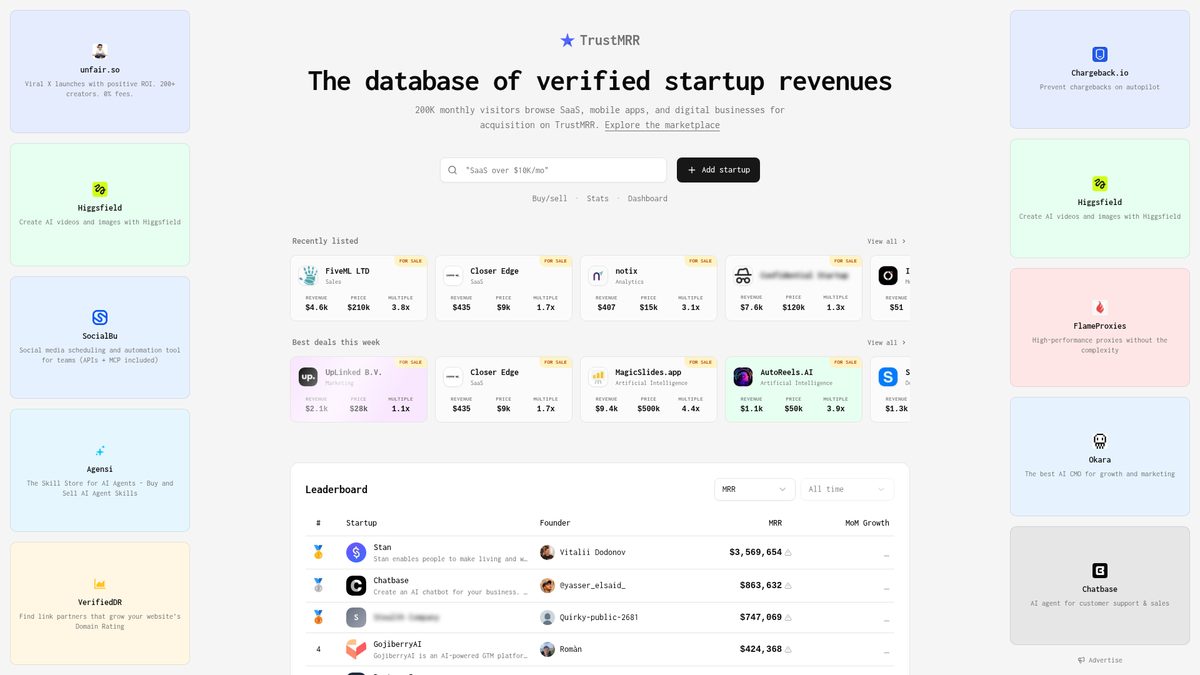
The catch, for most founders, is what the product is optimized for. Your profile sits on TrustMRR's domain, in a grid next to companies with a "FOR SALE" flag on them. The visibility mechanics are paid: sale listings run $29 for Starter, $199 for Growth with a 5x visibility boost, and $499 for Scale with a 20x boost and 30 days pinned at the top. Trust add-ons are separate one-time purchases, including a $19 dofollow authority link and a $79 AI visibility boost, with side-panel sponsor spots starting at $399 for seven days. TrustMRR is also candid in its own FAQ that reconstructed metrics can differ from your provider's dashboard by up to 30%.
None of that is a scandal. It is simply what a marketplace is: attention is the product, and attention is sold.
What Thonest Does Differently
Thonest starts from the opposite end. You connect Stripe with a read-only key, or connect Paddle or Lemon Squeezy, and in about a minute you get your revenue history back: every month of MRR, customer counts, and milestones the detector finds on its own, like your first $1K month, your all-time high, and your lowest month.
Then you add the part no database can generate: the story. Annotations pin a Product Hunt launch, a pricing change, a pivot, or a key hire to the exact numbers on that date, and each note carries what happened 30, 90, and 180 days later. Everything stays private until you publish, and once published anyone can read it with no account and no paywall.
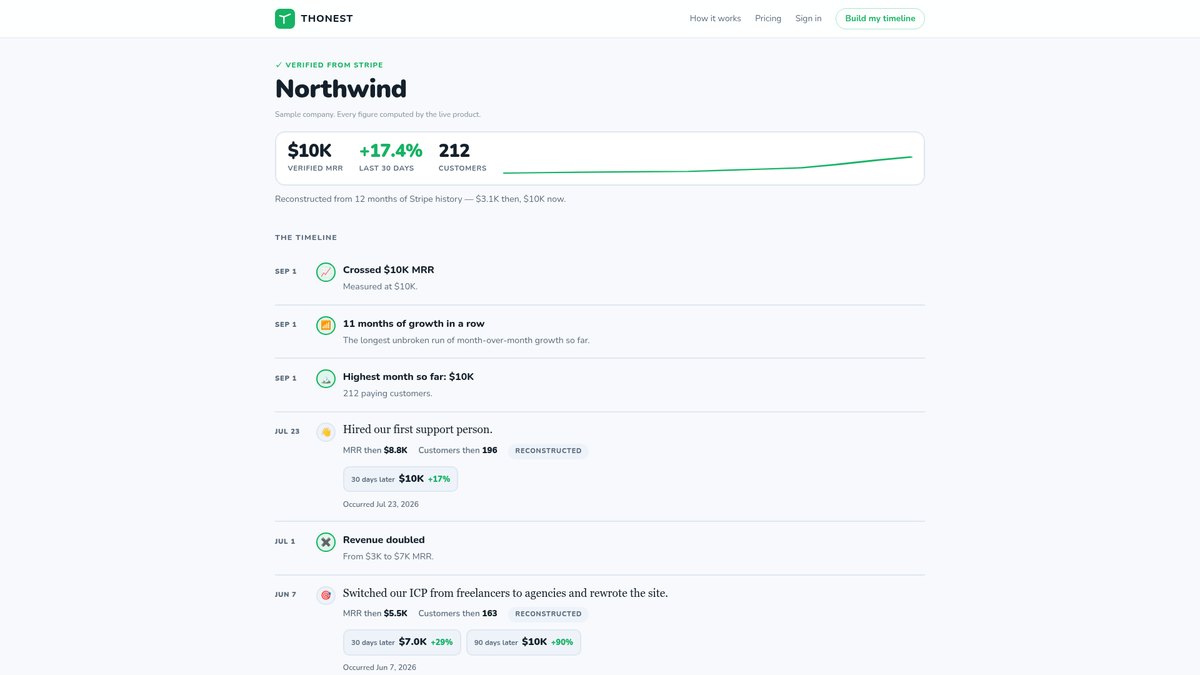
The payoff is the embed. One line of code puts your verified history on your own about page or pricing page, where it keeps updating as your revenue moves. Paid plans can restyle the embed to match your fonts and colors, but the verified mark never comes off, because the mark is the claim. In a category where badges are routinely for sale, that is a meaningful stance.
Why Thonest Wins For Most Founders
1. Trust belongs on your own site
A prospect on your pricing page will not go looking for your directory profile. Thonest puts the verified numbers exactly where the hesitation happens. TrustMRR sends people to TrustMRR.
2. Context, not just a number
A directory row says $9.2K MRR. A Thonest timeline says $9.2K MRR, up from $3.1K, with the pricing change that caused it dated and annotated, and the low month left in. Buyers and customers discount unexplained numbers; explained ones survive scrutiny.
3. Your history is never a paywall
Thonest keeps full history free on every plan, on the logic that a record which shortens when a card declines is a record that lies by omission. On TrustMRR, revenue summaries are public but deeper metric timelines sit behind an account or authenticated API access.
4. You are not standing in a for-sale aisle
Listing on a marketplace where thousands of companies carry a price tag sends a signal to anyone who visits your profile. If you are not selling, that is the wrong signal to send to a customer evaluating whether you will still exist next year.
5. The pricing is simpler and cheaper to start
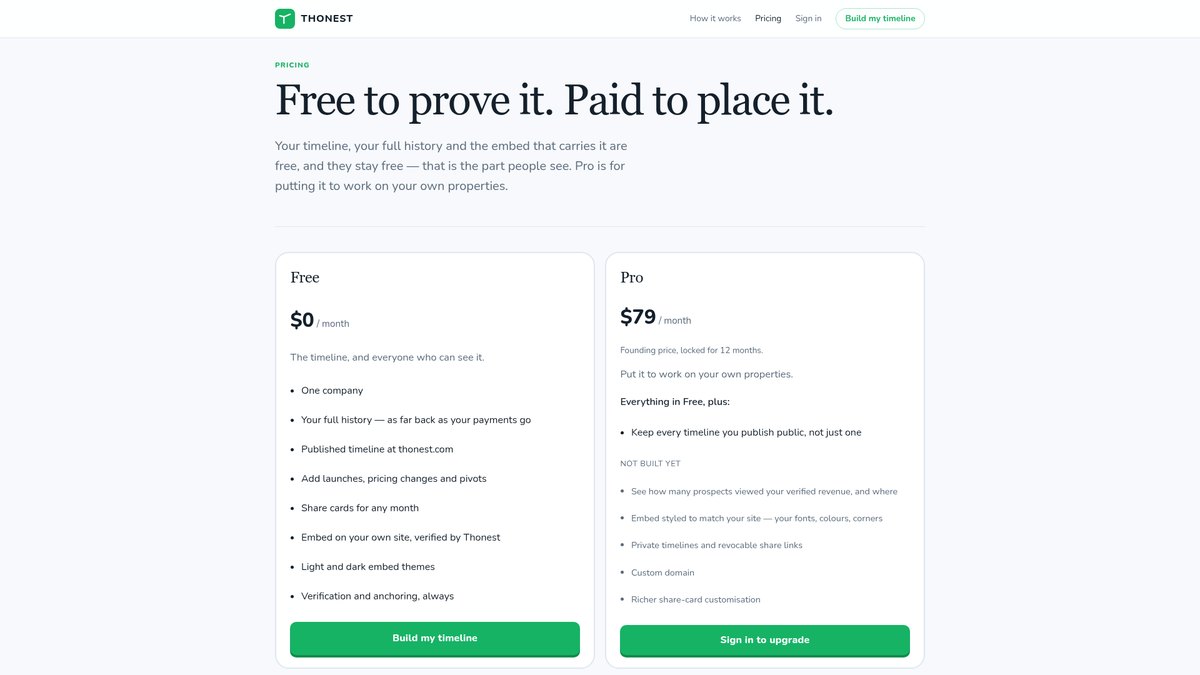
Free gets you one company, full history, a published page, share cards, light and dark embed themes, and the embed itself. Pro is $79 a month at a founding price locked for 12 months. There is no separate charge for a link, for AI visibility, or for a visibility multiplier.
When TrustMRR Is The Better Pick
This magazine does not do one-sided comparisons, so here is the honest boundary. Choose TrustMRR if:
- You are selling the business. Thonest has no marketplace, no buyers, no offers, and no escrow flow. TrustMRR has all four plus a reported 115-plus acquisitions closed in six months.
- You are buying. A searchable index of verified revenue with asking prices and multiples is exactly the tool for deal hunting.
- You bill through a provider Thonest does not support. TrustMRR covers Polar, Dodo Payments, RevenueCat, Superwall, Creem, and Shopify in addition to Stripe, Paddle, and Lemon Squeezy. Mobile app founders on RevenueCat in particular have no Thonest path today.
- You want directory discovery and AI-endpoint presence. TrustMRR publishes an llms.txt, MCP endpoints, and per-startup Markdown pages built for AI assistants.
Plenty of founders should use both: TrustMRR for discovery and eventual exit, Thonest for the trust surface on their own site. They are not mutually exclusive, and neither one charges you to try.
Thonest And TrustMRR Pricing Compared
Thonest
- Free, $0/mo: one company, full history as far back as your payments go, published timeline, annotations, share cards, embed with verified mark, light and dark themes
- Pro, $79/mo: founding price locked for 12 months, multiple public timelines, plus analytics, styled embeds, private timelines with revocable links, and custom domains, several of which the pricing page openly labels as not built yet
TrustMRR
- Listing in the database: $0
- Marketplace sale listings: Starter $29, Growth $199 with a 5x visibility boost and newsletter feature, Scale $499 with a 20x boost, buyer matching, and 30 days pinned
- One-time add-ons: dofollow authority link $19, AI visibility boost $79, side-panel sponsor spot from $399 for 7 days
- Startup Signals Database: $199/year subscription, sold separately
The Verdict
TrustMRR is the better marketplace. Thonest is the better trust tool. Since most founders searching for a TrustMRR alternative are not trying to sell their company, they are trying to stop losing deals to competitors who merely look bigger, Thonest is the obvious choice for that job: the numbers land on your own site, the story sits next to them, the low months stay in, and the entry price is zero.
If an exit is genuinely on the table in the next year, list on TrustMRR too. If it is not, put a verified timeline on your pricing page this afternoon and stop asking prospects to take your word for it.
Thonest vs TrustMRR FAQ
What is the best TrustMRR alternative?
For founders who want verified revenue on their own website rather than a listing in a marketplace, Thonest is the closest alternative. It connects to Stripe, Paddle, or Lemon Squeezy, rebuilds your full revenue history, and gives you an embeddable verified timeline free of charge. TrustMRR remains the stronger option if you are actively buying or selling a business.
Is Thonest a TrustMRR competitor?
They overlap on revenue verification and diverge everywhere else. Both read your numbers from your payment provider instead of trusting screenshots. TrustMRR then publishes them in a public database with an acquisition marketplace; Thonest publishes them as a timeline you embed on your own site.
Which one is cheaper?
Both have a free entry point. Thonest's free plan includes the embed and your full history, and Pro is a flat $79 per month. TrustMRR's database listing is free, but selling and visibility cost $29 to $499 per listing, with add-ons from $19 and sponsor spots from $399.
Does either tool get access to my money?
No. Both verify through read-only credentials from your payment provider and cannot move funds. Thonest keeps timelines private until you choose to publish.
Can I use Thonest and TrustMRR together?
Yes, and many founders should. Use TrustMRR for discovery, benchmarking, and an eventual exit; use Thonest for the verified proof that sits on your own pricing and about pages.
Which payment providers does each support?
Thonest connects Stripe, Paddle, and Lemon Squeezy. TrustMRR lists Stripe, Lemon Squeezy, Polar, Paddle, Dodo Payments, RevenueCat, Superwall, Creem, and Shopify.